
.svg)

Summary
Demoboost is a credible enterprise demo automation platform: 4.9 on G2 across 103 reviews, popular with presales-led organizations and European mid-market and enterprise companies (Bosch, Celonis, PwC, Hitachi, AvePoint). Their pitch is breadth: six demo formats (HTML tours, sandbox, live overlays, screenshot, mobile, video) wrapped in a "demo automation to revenue intelligence" narrative aimed at presales leaders.
If you're searching for Demoboost alternatives, three things are probably driving that evaluation in 2026: there's no free plan and no free trial (the floor is $375/mo Start Up for 2 seats), the modules buyers want most are gated to the top of the stack (Live Demo Overlay is Enterprise-only; Sandbox is Growth-only at $1,200/mo), and G2 reviewers consistently flag demo loading speed and editor performance at scale.
The seven strongest alternatives in 2026 are Storylane, Walnut, Reprise, Navattic, Consensus, Supademo, and Arcade. Storylane is the broadest fit for B2B SaaS GTM teams that want format versatility, accessible pricing across team sizes (Free + $40/mo Starter), full-stack AI in production, multi-format Hubs, the most reviewed and highest-ranked interactive demo software platform on G2, and a live AI sales agent (RepX) that no Demoboost product matches.
Quick comparison: Demoboost vs. top 7 alternatives
Try Storylane Free · Book a Demo
A note on perspective: Demoboost is one of the strongest presales-positioned platforms in the category, and their European enterprise footprint is real. They've also been one of the more interesting competitors to evaluate because their positioning (six demo formats, presales-native, EU enterprise) is distinct from the marketing-led HTML-first cohort. What follows is the honest breakdown of where Demoboost fits today, what specifically drives buyers to evaluate alternatives, and which platforms I'd point you toward depending on what you're trying to solve.
Why look for a Demoboost alternative
Three switching triggers come up in nearly every Demoboost evaluation I see.
1. No free plan, no free trial, and a high entry price
Demoboost's pricing page starts at $375/mo for the Start Up plan (2 seats). There's no self-serve free tier and no free trial. For comparison, Storylane offers a free plan and a $40/mo Starter, Supademo starts at $27/mo, and Arcade at $32/mo. If you're a team of 3-5 trying to validate whether demo automation tools actually move pipeline before committing budget, Demoboost requires a sales conversation and a budget line item before you touch the product.
G2 reviewer (mid-market, Spring 2026):
"I wish there was a free trial. We had to commit before we could evaluate whether it actually fit our workflow."
2. The features you want most are gated to the most expensive plans
Demoboost advertises six demo formats, but the two that often drive the buying decision are locked behind higher tiers:
- Live Demo Overlay (the overlay that enhances live sales calls) is Enterprise-only. No published pricing.
- Sandbox Demos are Growth-only, starting at $1,200/mo.
So if you're a presales leader evaluating Demoboost specifically for live overlays or sandbox environments, the actual entry point is significantly higher than the listed $375/mo. Storylane includes Sandbox and Presenter Mode (their equivalent of a live overlay) on plans starting far lower.
3. Editor performance and demo loading speed at scale
G2 reviewers consistently flag two UX friction points: the editor can feel slow when working with complex, multi-step demos, and published demos sometimes take noticeably long to load for the end viewer. For teams building 50+ demos and embedding them across high-traffic pages, loading speed directly impacts conversion. This shows up in reviews from both mid-market and enterprise accounts.
G2 reviewer (enterprise, Winter 2025):
"The demo editor can lag significantly with larger, more complex tours. Loading times for published demos could be better."
What Demoboost is
Before comparing alternatives, here's a fair summary of what Demoboost does well and where it sits in 2026.
Demoboost is a demo automation platform built for presales-led organizations. It offers six demo formats: HTML product tours, sandbox environments, live demo overlays, screenshot demos, mobile demos, and video demos. The platform wraps these into a "demo automation to revenue intelligence" narrative, tracking engagement across the buyer journey and feeding insights back to presales and sales teams.
Where Demoboost is strong:
- Genuine presales DNA. The product is designed around presales workflows, not retrofitted from a marketing-first tool.
- European enterprise traction. Bosch, Celonis, PwC, Hitachi, AvePoint.
- Six format breadth. Few competitors match that range under one roof.
- 4.9 G2 rating. The rating is high, though the review count (103) is notably lower than leaders like Storylane (1,400+) or Consensus (450+).
Where Demoboost falls short:
- No free plan or trial. High floor price.
- Key features gated to expensive tiers.
- Editor and loading performance concerns at scale.
- Smaller G2 review base makes it harder to validate across use cases.
- No AI sales agent equivalent (vs. Storylane's RepX).
Demoboost pricing breakdown (June 2026)
Source: demoboost.com/pricing, verified June 2026.
How we evaluated alternatives
I evaluated every platform against four criteria that matter most to B2B SaaS teams making this decision in 2026:
- Format versatility: Does it cover HTML demos, screenshot demos, video demos, sandbox environments, and some form of live call enhancement? The more formats under one roof, the fewer point solutions you're stitching together.
- Pricing accessibility: Is there a free plan or trial? What's the real entry point for a team of 3-5? How does pricing scale as you add seats and features?
- AI capabilities in production: Not "AI" on the roadmap or in a press release. AI features that are shipping today and actually change the workflow: auto-generated guides, voiceovers, personalization at scale, AI-powered search.
- G2 social proof and market validation: Rating, review count, and the substance of what reviewers actually say. A 4.9 with 103 reviews tells a different story than a 4.8 with 1,400+.
I also looked at Salesforce/HubSpot integration depth, analytics and deal intelligence capabilities, enterprise readiness (SSO, SOC2, custom domains), and whether the platform supports a demo center or hub model for packaging multiple assets.
The 7 best Demoboost alternatives in 2026
1. Storylane: best overall Demoboost alternative
G2 rating: 4.8 · G2 reviews: 1,400+ · Free plan: Yes · Starting price: $40/mo (Starter)
If I had to recommend one platform to replace Demoboost for most B2B SaaS teams, it's Storylane. Not because I work here (though I do, and I'll be transparent about that throughout), but because Storylane covers the widest range of use cases at the most accessible price point, with AI that's actually in production and a deal intelligence layer that connects demo engagement to pipeline.
For a detailed head-to-head, see the full Demoboost vs Storylane comparison.
Why Storylane wins as the top Demoboost alternative:
- Format versatility that matches or exceeds Demoboost: HTML demos, screenshot demos, video demos, Sandbox environments, and Presenter Mode (Storylane's equivalent of a live demo overlay). All of these are available without gating the most useful formats to the most expensive tier.
- Free plan + $40/mo Starter: You can evaluate the product, build real demos, and prove value before committing budget. Demoboost requires $375/mo minimum with no trial.
- Full-stack AI in production: AI-generated step-by-step guides from captured screens. AI voiceovers and avatar presenters. Natural language HTML editing. AI-powered Hub creation. These ship today, not next quarter.
- Hubs (multi-format deal rooms): Package interactive demos, sandbox demos, videos, PDFs, case studies, and ROI calculators into a single trackable link for buying committees. Demoboost doesn't have an equivalent.
- RepX: AI sales agent. A 24/7 AI rep trained on your product docs, call transcripts, and sales assets. It runs discovery, qualifies prospects, delivers interactive demos on demand, and routes sales-ready leads to your CRM. No Demoboost product matches this.
- Deal intelligence: Step-level engagement tracking, stakeholder-level Hub analytics, account-level aggregation, real-time Slack notifications, and HubSpot/Salesforce sync. You see exactly who on the buying committee is engaged and what they care about.
- 1,400+ G2 reviews (4.8 stars). The largest review base in the category by a wide margin. When you're reading G2 reviews, the depth and breadth of feedback across verticals, company sizes, and use cases is unmatched.
Where Storylane is lighter than Demoboost:
- Demoboost's presales-specific workflow tooling (presales room features, speaker notes built for SE handoffs) is more deeply integrated into the presales persona. If your buying motion is exclusively presales-led and you don't need marketing or CS use cases, Demoboost's presales-first design is a legitimate differentiator.
Try Storylane Free · Book a Demo
2. Walnut: best for sales-led live demos with deep Salesforce workflows
G2 rating: 4.6 · G2 reviews: 250+ · Free plan: No · Starting price: Custom (estimated $10K+/yr)
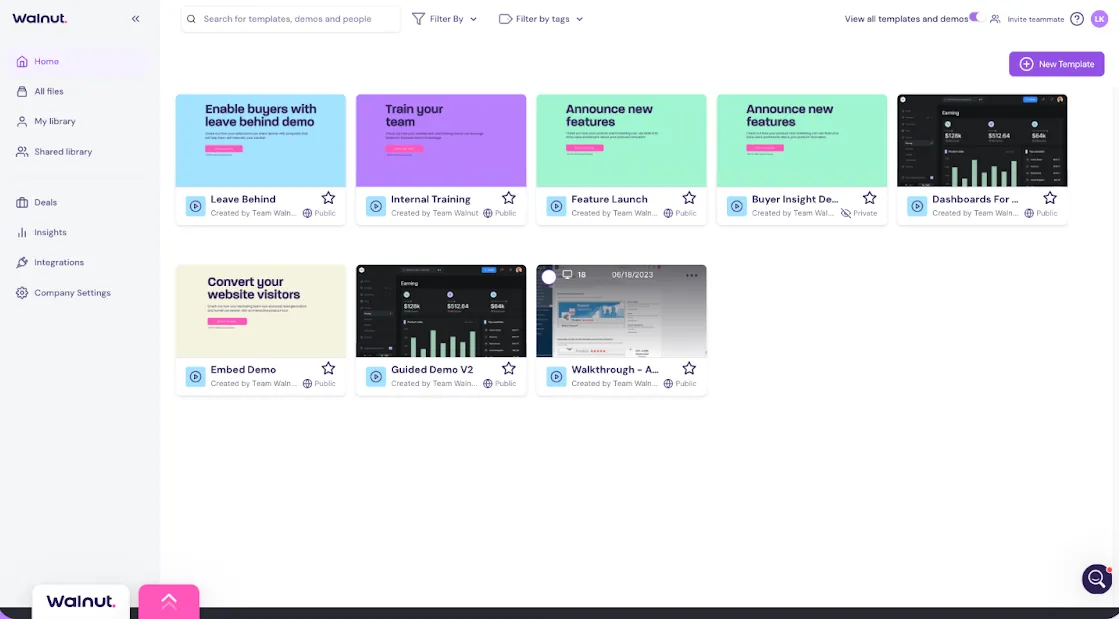
Walnut is built for sales teams that live inside Salesforce and need to run personalized, interactive demos directly within the sales workflow. If your motion is heavily sales-led, your reps are running 50+ demos a month, and Salesforce is the center of gravity, Walnut has deep integration hooks that most competitors don't match.
For more options in this space, see Walnut alternatives.
Strengths:
- Deep Salesforce integration: demo creation, tracking, and analytics tied to Salesforce records natively.
- Sales-centric UI designed around the rep persona, not the marketer.
- Personalization workflows that let reps customize demos at scale without touching the editor.
Weaknesses:
- No free plan or trial. Custom pricing means you're committing before you evaluate.
- Marketing and CS use cases are an afterthought. If you need website embeds, event demos, or onboarding content, Walnut isn't the right fit.
- HTML-only capture. No screenshot, video, or sandbox formats.
- Smaller G2 review base than Storylane, Consensus, or Arcade.
When to choose Walnut over Demoboost: Your motion is purely sales-led, Salesforce is your CRM, and your reps need tight CRM-to-demo workflows. You don't need marketing embeds, sandbox environments, or multi-format Hubs.
3. Reprise: best for enterprise procurement and complex compliance buying
G2 rating: 4.3 · G2 reviews: 130+ · Free plan: No · Starting price: Custom (estimated $24K+/yr)
Reprise is the platform you evaluate when your buying process involves multi-month procurement cycles, infosec questionnaires, and compliance gates that would make most startups walk away. They've built their reputation on enterprise readiness: sandbox environments that replicate full product instances, SOC2 and ISO compliance documentation, and a sales motion built around enterprise RFP responses.
For more options in this space, see Reprise alternatives.
Strengths:
- True sandbox environments (Reprise Replicate) that mirror live product instances for hands-on evaluation.
- Enterprise compliance posture: SOC2, ISO, and dedicated infosec support.
- Built for the procurement process, not just the demo process.
Weaknesses:
- High price point. Estimated $24K+/yr minimum puts it out of reach for SMB and most mid-market teams.
- No free plan or trial.
- G2 rating (4.3) is the lowest among the seven alternatives listed here. Reviewers cite complexity and a steep learning curve.
- Marketing use cases (website embeds, email campaigns) are secondary.
When to choose Reprise over Demoboost: Your enterprise deals require full sandbox environments that pass procurement review, and you need a vendor that can clear complex compliance gates. You're willing to pay a premium for that.
4. Navattic: best for marketing teams building HTML demos with mature commenting
G2 rating: 4.6 · G2 reviews: 140+ · Free plan: Yes (limited) · Starting price: $500/mo (Base)
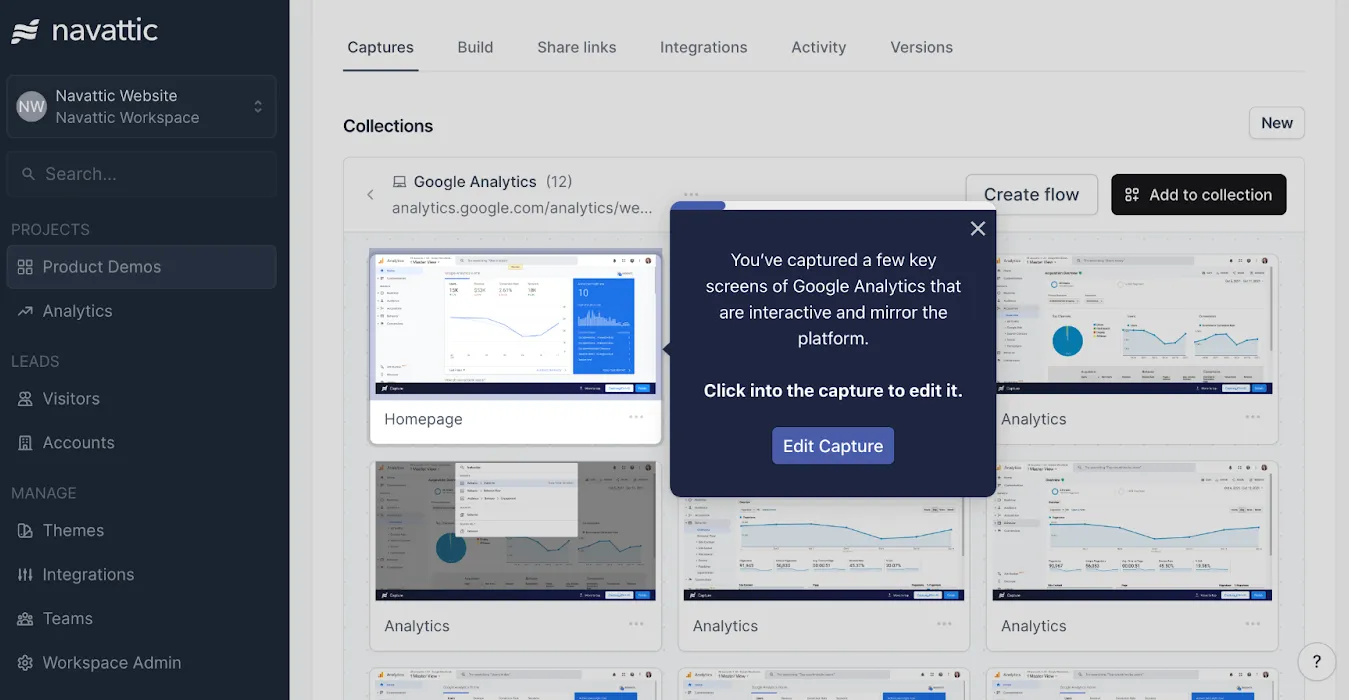
Navattic was one of the first platforms to focus specifically on marketing-led interactive demos. Their strength is HTML capture with a clean, marketer-friendly editor and a commenting/review workflow that makes it easy for marketing teams to collaborate on demo content before publishing.
For more options in this space, see Navattic alternatives.
Strengths:
- Mature commenting and review workflow. Marketing teams can leave inline feedback, request changes, and approve demos before they go live.
- Clean HTML editor with a focus on marketing use cases: website embeds, landing pages, email campaigns.
- Free plan available (limited to one published demo).
Weaknesses:
- No sandbox, no video demos, no live call overlay. If you need format breadth, Navattic is HTML-only.
- $500/mo Base plan is a significant jump from the free tier. No mid-range option for growing teams.
- Smaller G2 review base (140+) and less traction outside of marketing-led use cases.
- Sales and presales workflows are limited compared to Storylane, Walnut, or Demoboost.
When to choose Navattic over Demoboost: You're a marketing team that primarily needs HTML interactive demos for website embeds and campaigns, you value a collaborative review workflow, and you don't need sandbox, video, or live call features.
5. Consensus: best for presales-adjacent teams running AI-generated video demos at scale
G2 rating: 4.7 · G2 reviews: 450+ · Free plan: No · Starting price: Custom (estimated $12K+/yr)
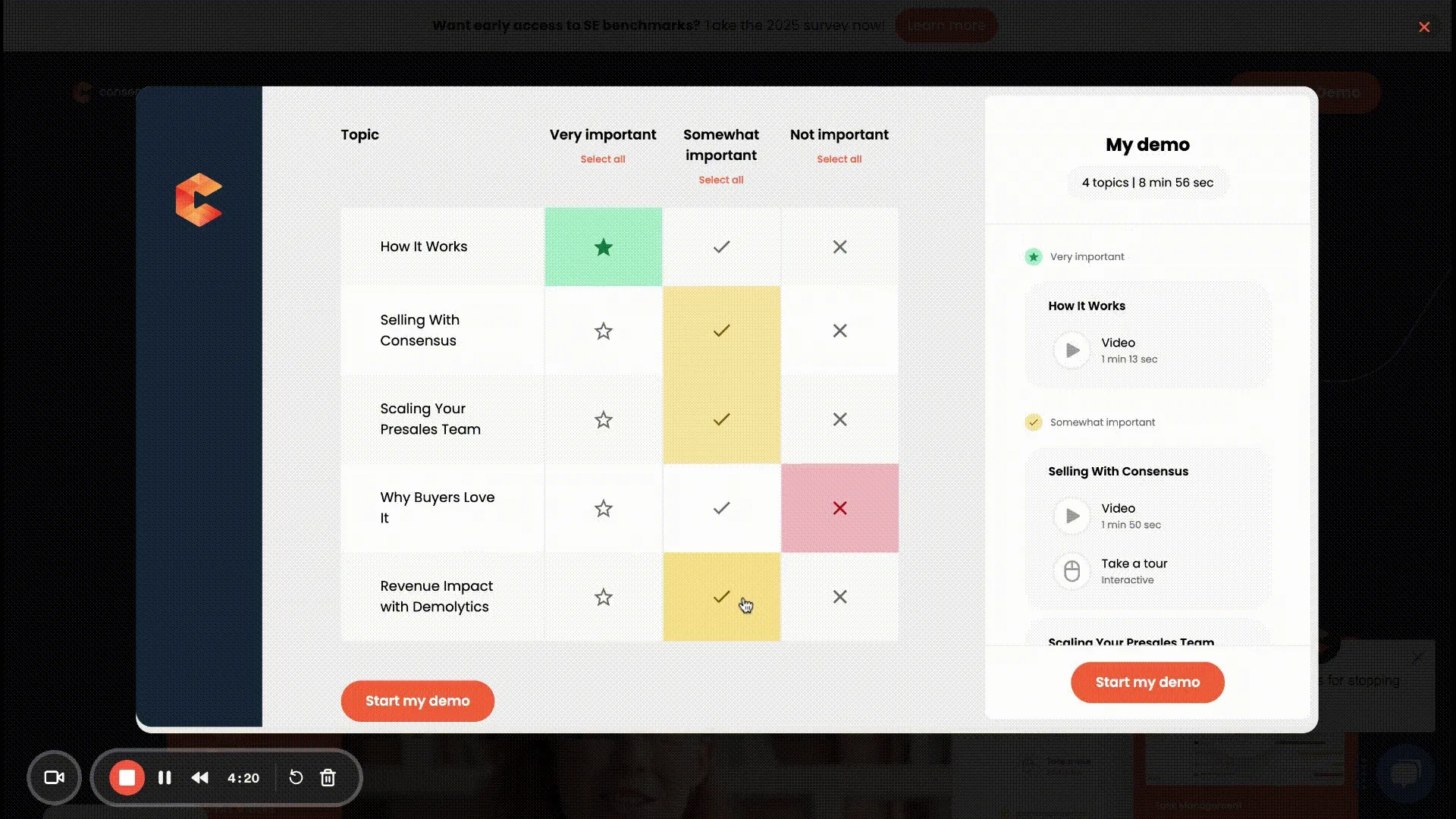
Consensus has carved out a distinct position: AI-generated video demos that let buyers self-select their persona and see a personalized video experience without a live rep. If your motion involves high demo volume, a large product with multiple personas, and a presales team that's drowning in repetitive first-call demos, Consensus can automate a meaningful chunk of that workload.
For more options in this space, see Consensus alternatives.
Strengths:
- AI-generated video demos that let buyers choose their path based on role, pain point, or use case.
- Strong presales and demo request automation. Reduces the volume of live first-call demos.
- 450+ G2 reviews (4.7 stars). Solid social proof, especially in enterprise and mid-market presales.
Weaknesses:
- Video-first format. No HTML interactive demos, no sandbox, no live call overlay. If you need clickable, hands-on product experiences, Consensus isn't the right tool.
- No free plan or trial. Custom pricing with a sales-led buying process.
- Less suited for marketing-led use cases (website embeds, email campaigns, landing pages).
- The AI-generated video experience can feel scripted compared to a genuinely interactive HTML demo.
When to choose Consensus over Demoboost: You're a presales-adjacent team that needs to automate high-volume first-call demos with persona-based video experiences. You're comfortable with video as your primary format and don't need HTML interactivity.
6. Supademo: best for solo creators and SMB teams wanting multi-format demos
G2 rating: 4.7 · G2 reviews: 250+ · Free plan: Yes · Starting price: $27/mo (Pro)
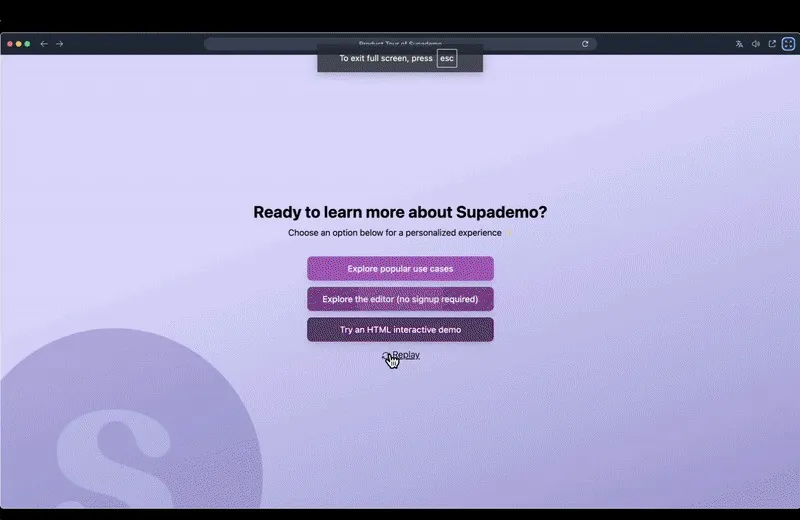
Supademo is the platform I'd recommend for solo creators, small teams, and SMBs that want to get started with demo automation without a significant budget commitment. The free plan is generous, the $27/mo Pro plan is the lowest paid entry point in the category, and the product covers screenshot demos, video demos, and basic HTML interactivity.
For more options in this space, see Supademo alternatives.
Strengths:
- Lowest paid entry point in the category: $27/mo Pro.
- Generous free plan for getting started.
- Multi-format: screenshot, video, and basic HTML demos.
- Clean, intuitive UI. Low learning curve.
Weaknesses:
- HTML capture capabilities are more limited than Storylane, Walnut, or Navattic. Complex product UIs may not capture cleanly.
- No sandbox environments, no live call overlay, no Hub/deal room functionality.
- Analytics and deal intelligence are basic compared to platforms built for mid-market and enterprise sales.
- Enterprise features (SSO, SOC2, custom domains) are limited or unavailable.
When to choose Supademo over Demoboost: You're a solo creator, small team, or SMB that needs to create multi-format demos quickly and affordably. You don't need enterprise features, deep CRM integration, or sandbox environments.
7. Arcade: best for design-led marketing teams running screenshot demos
G2 rating: 4.6 · G2 reviews: 300+ · Free plan: Yes · Starting price: $32/mo (Pro)
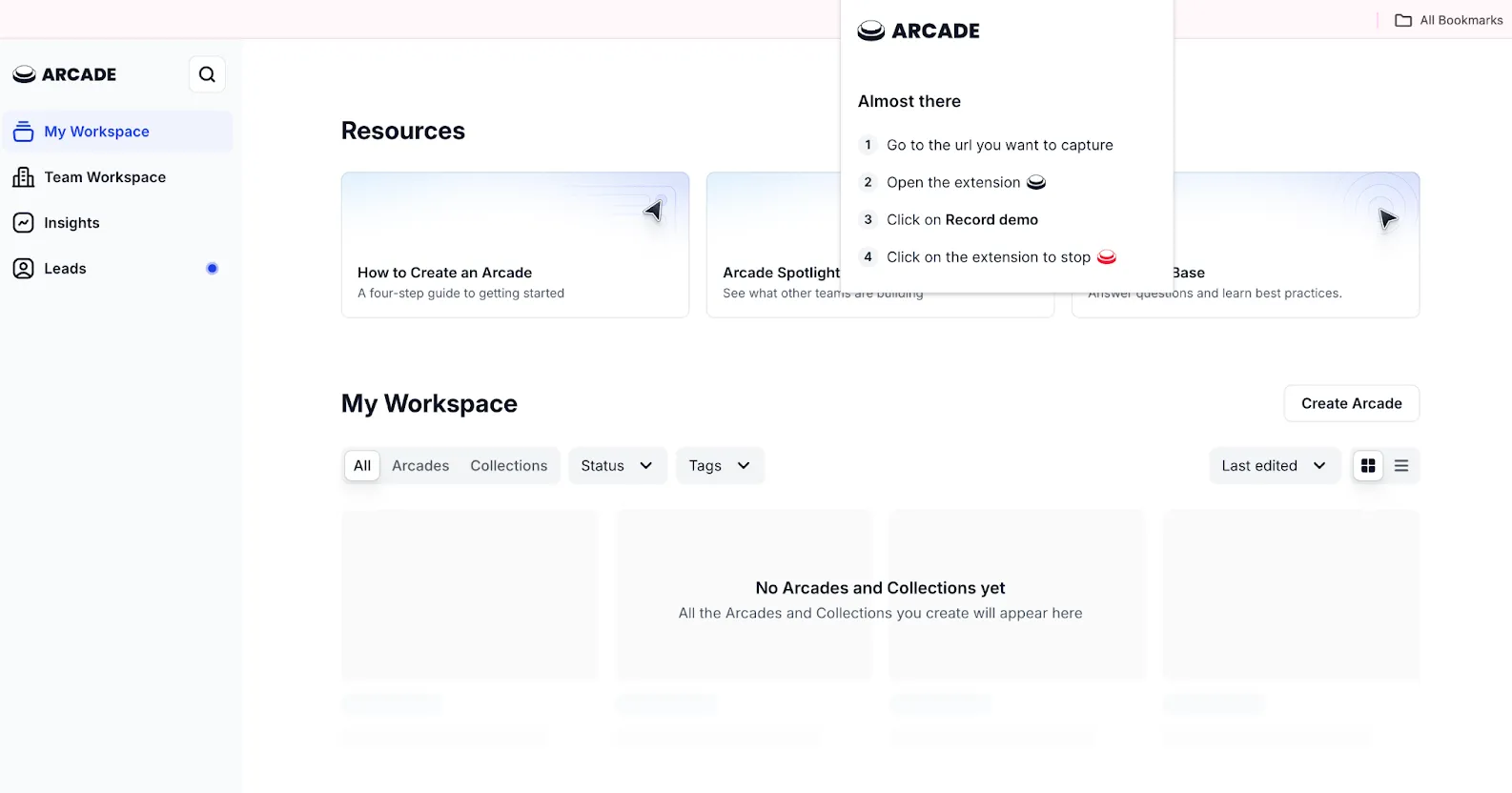
Arcade is the tool that marketing designers love. If your team prioritizes visual polish, branded demo experiences, and screenshot-based product tours that look great in email campaigns and landing pages, Arcade delivers on aesthetics. Their editor is design-forward, with strong branding controls and a clean output format.
For more options in this space, see Arcade alternatives.
Strengths:
- Design-first editor with strong branding and visual customization.
- Free plan available.
- Clean screenshot-based demos that look polished in marketing contexts.
- 300+ G2 reviews with strong satisfaction among design-led marketing teams.
Weaknesses:
- Screenshot-first. HTML interactive demos are limited. No sandbox, no live call overlay.
- Sales and presales use cases are an afterthought. No CRM integration depth, no deal room functionality.
- Analytics are basic compared to Storylane, Walnut, or Consensus.
- Not built for enterprise procurement. Limited SSO, compliance, and security features.
When to choose Arcade over Demoboost: You're a design-led marketing team that primarily needs visually polished screenshot demos for campaigns and landing pages. You don't need HTML interactivity, sandbox environments, or sales-centric workflows.
Comparison matrix: all 7 Demoboost alternatives side by side
How to choose the right Demoboost alternative
Here's the decision framework I'd use if I were evaluating these platforms today:
Start with your primary use case:
- "We need an all-in-one platform for marketing, sales, and CS." Storylane. No other platform covers as many use cases under one roof at an accessible price point. Try Storylane Free.
- "We're a sales-led org that lives in Salesforce." Walnut. Their Salesforce integration depth is the best in the category.
- "We're buying for enterprise procurement and need sandbox + compliance." Reprise. Built for the procurement process, not just the demo process.
- "We're a marketing team that needs HTML demos with a strong review workflow." Navattic. Clean editor, mature commenting, marketing-first.
- "We need to automate high-volume first-call demos with video." Consensus. AI-generated video demos reduce presales workload at scale.
- "We're a small team or solo creator on a tight budget." Supademo. Lowest entry point, generous free plan.
- "We're a design-led marketing team that needs polished screenshot demos." Arcade. Best visual editor in the category.
Then ask these tie-breaker questions:
- Do you need a free plan or trial? Storylane, Supademo, Arcade, and Navattic offer free tiers. Walnut, Reprise, Consensus, and Demoboost do not.
- Do you need sandbox environments? Only Storylane, Reprise, and Demoboost offer them. And Demoboost gates Sandbox to the $1,200/mo Growth plan.
- Do you need AI features in production today? Storylane and Supademo are shipping AI-generated guides, voiceovers, and personalization now. Most others are still roadmap or limited.
- Do you need a live call enhancement? Storylane (Presenter Mode) and Demoboost (Live Demo Overlay, Enterprise-only) are the only options.
- How important is G2 social proof? Storylane (1,400+ reviews) and Consensus (450+) have the largest validated review bases. Demoboost (103) has the highest rating but the smallest sample.
The bottom line
Demoboost is a strong platform with a legitimate presales-first approach and real European enterprise traction. If you're a presales-led organization in the EU mid-market or enterprise segment, and you can justify the budget, it belongs on your shortlist.
But for most B2B SaaS GTM teams evaluating demo automation in 2026, the alternatives have pulled ahead on pricing accessibility, format breadth without feature gating, AI capabilities in production, and overall G2 market validation.
Storylane is the broadest fit: it covers the most use cases, ships the most advanced AI features, includes Hubs for multi-format deal rooms, offers the only AI sales agent in the category (RepX), and does it all starting at $0/mo with a real free plan.
If Storylane doesn't fit your specific motion, Walnut (Salesforce-native sales), Reprise (enterprise procurement), Navattic (marketing HTML), Consensus (video automation), Supademo (SMB/solo), and Arcade (design-led marketing) each win in their lane.
Try Storylane Free · Book a Demo · See Storylane pricing
Frequently asked questions
What are the best alternatives to Demoboost?
The seven best Demoboost alternatives in 2026 are Storylane, Walnut, Reprise, Navattic, Consensus, Supademo, and Arcade. Storylane is the best overall alternative for most B2B SaaS teams because it combines format versatility, AI features in production, accessible pricing (Free + $40/mo), and the largest G2 review base in the category (1,400+ reviews, 4.8 stars).
Does Demoboost have a free trial?
No. Demoboost does not offer a free plan or a free trial as of June 2026. The lowest entry point is the Start Up plan at $375/mo for 2 seats. You need to go through a sales conversation to access the product. Alternatives like Storylane, Supademo, and Arcade offer free plans that let you build and publish demos before committing budget.
What is Demoboost's pricing in 2026?
Demoboost's pricing starts at $375/mo for the Start Up plan (2 seats), which includes HTML tours, screenshot demos, mobile demos, and video demos. The Growth plan at $1,200/mo adds Sandbox Demos. The Enterprise plan (custom pricing) adds Live Demo Overlay. Key features like Sandbox and Live Overlay are gated to higher tiers.
How does Storylane compare to Demoboost?
Storylane offers broader format coverage at a lower price point: HTML demos, screenshot demos, video demos, Sandbox, and Presenter Mode all available without gating critical features to top-tier plans. Storylane also offers a free plan, full-stack AI in production, multi-format Hubs, RepX (an AI sales agent), and 1,400+ G2 reviews at 4.8 stars. Read the full Demoboost vs Storylane comparison.
Which demo automation platform is best for presales teams?
For presales-specific workflows, Demoboost and Consensus are both strong options. Demoboost is built around presales personas with native presales room features and speaker notes. Consensus automates high-volume first-call demos with AI-generated video. However, Storylane covers presales use cases (Sandbox, Presenter Mode, deal intelligence) while also serving marketing, sales, and CS teams from the same platform.
What is the best free demo automation tool?
Storylane offers the most capable free plan among demo automation platforms: you can build and publish one interactive demo with HTML or screenshot capture, basic analytics, and integrations. Supademo and Arcade also offer free plans. If you need to validate demo automation before committing budget, Storylane's free plan is the best starting point.
Which interactive demo software has the best AI features?
Storylane has the most advanced AI capabilities in production as of June 2026: AI-generated step-by-step guides, AI voiceovers and avatar presenters, natural language HTML editing, AI-powered Hub creation, and RepX (an AI sales agent). Supademo also offers AI-generated guides and voiceovers. Most other platforms have limited or roadmap-stage AI features.
Is there a cheaper alternative to Demoboost?
Yes. Several alternatives are significantly cheaper than Demoboost's $375/mo floor. Supademo starts at $27/mo, Arcade at $32/mo, and Storylane at $40/mo. All three also offer free plans. Storylane provides the closest feature parity to Demoboost at a fraction of the price.
What is the best demo automation platform for enterprise?
For enterprise buyers, Storylane and Reprise are the strongest options. Storylane offers SSO, SOC2, custom domains, white-label branding, and is trusted by Fortune 1000 companies, with 1,400+ G2 reviews providing extensive validation. Reprise is built specifically for the enterprise procurement process with sandbox environments and deep compliance documentation. Demoboost also has enterprise capabilities, particularly in the European market.
Does Demoboost support sandbox demos?
Yes, but only on the Growth plan ($1,200/mo) and above. Sandbox demos are not available on the Start Up plan ($375/mo). Alternatives like Storylane and Reprise also offer sandbox environments, with Storylane making them available at lower price points.
About this guide
This guide is researched, written, and maintained by the Storylane content team. We compare platforms based on publicly available pricing, G2 reviews, published feature documentation, and hands-on evaluation where possible. Storylane is one of the platforms compared in this guide, and we're transparent about that throughout. We update this guide quarterly or when significant pricing or feature changes occur. Last verified: June 2026.
About the author
Ranga Kaliyur is a Product Marketing Lead at Storylane. He covers demo automation strategy, competitive intelligence, and B2B SaaS GTM topics. You can find more of his work on the Storylane blog and check out interactive demo examples from Storylane customers.