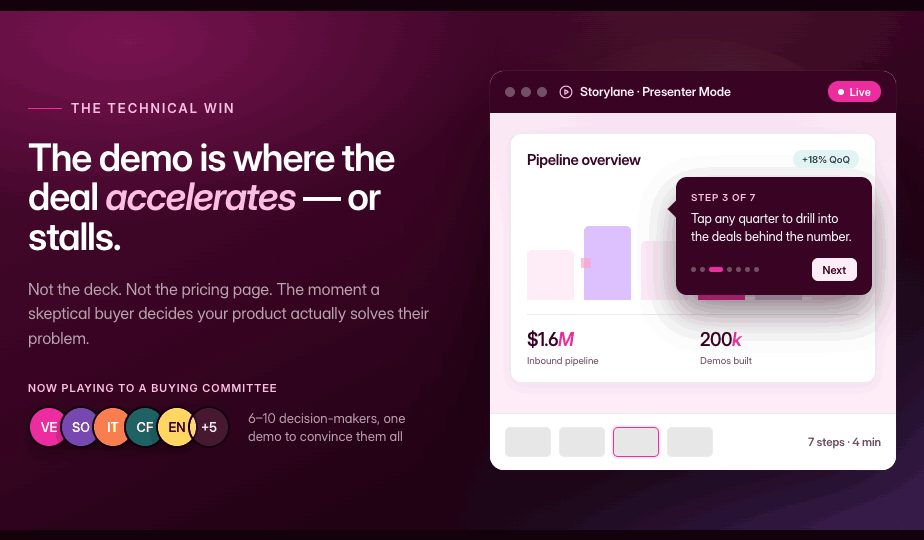
Your demo is the moment where the deal either accelerates or stalls. Not your deck, not your proposal, not your pricing page. The live (or interactive) demo is where a skeptical technical buyer decides whether your product actually solves their problem or is just another vendor promising things it can't deliver.
This guide covers the full demo lifecycle, from discovery through follow-up, written specifically for the people who own that moment: sales engineers, solutions consultants, and presales professionals. You will find concrete practices, real examples, and implementation checklists you can apply to your next call. No generic sales advice. No "just be more engaging." Craft-level detail for practitioners who already know how to sell and want to demo better.
Sales engineer vs. solutions consultant vs. presales: same job, different label
If you've searched for "sales engineer demo tips" and "solutions consultant demo tips" in the same week, you're not alone. The titles sound different, but in practice they describe the same function: the technical expert who runs product demos, manages proof-of-concept evaluations, and translates buyer pain into product fit during the deal cycle.
The differences are mostly organizational. Some companies call the role "sales engineer." Others prefer "solutions consultant" or "solutions architect." A few simply use "presales." The core responsibility is identical: you own the technical win. Throughout this guide, I use SE, SC, and presales interchangeably. If a tip works for a sales engineer demo, it works for a solutions engineer demo, a presales demo, or whatever your company happens to call the same work.
Before the demo: discovery and prep
A strong demo starts well before you share your screen. The outcome of your prep work is a demo that feels like a conversation about the buyer's specific situation, not a product tour they could have watched on your website.
Run discovery first (never demo blind)
The single most common mistake SEs make is demoing before they understand the problem. If your first live interaction is a product walkthrough, you are guessing what matters to the buyer, and guessing is how you lose deals to a competitor who asked better questions.
Discovery gives you the information you need to tailor the demo to their pain, their workflow, and their decision criteria. Without it, you default to the "harbor tour," which as sales engineering leader Chris White puts it,
It takes longer to prepare a short, concise demo than it does to just give the harbor tour. But the latter doesn't sell. Limit the demo to the 'critical few' rather than the 'insignificant many' that make demos so overwhelming and confusing.
Example: Before a demo for a mid-market fintech company, your discovery call reveals that their SE team rebuilds demo environments from scratch for every prospect, losing roughly 4 hours per demo. That single insight reshapes your entire demo: you now open on environment reliability, not on feature breadth.
How you can implement it:
- Block 15-30 minutes for discovery before every demo, even if the AE already ran a call
- Document the buyer's top 2-3 pain points, current workflow, and decision criteria
- Ask who else will be on the demo call and what they care about
- Confirm the technical environment (browser, integrations, security requirements) so nothing surprises you live
- Share your agenda 24 hours before the call so the prospect arrives prepared
Set a clear advancing goal
Every demo needs a defined next step before you start. "Show them the product" is not a goal. "Get agreement to start a two-week technical evaluation" is.
Example: For an enterprise account, your advancing goal might be: "Secure a follow-up call with their IT security team to discuss SSO and compliance requirements." For a mid-market deal: "Get the prospect to agree to a hands-on sandbox trial."
How you can implement it:
- Write down one specific advancing goal before every demo
- Share it with your AE so you're aligned on the ask
- Build the demo flow to arrive naturally at that goal
- If the demo goes off-track, use the goal to refocus: "I want to make sure we cover what you'd need to move forward on X"
Build a flexible agenda (loose script, not a rigid deck)
A demo agenda keeps you on track without locking you into a slide-by-slide march. The best SEs use a loose script: they know the three to four key moments they want to hit, but they stay flexible enough to follow the buyer's questions.
Example: Your prospect told you in discovery that they care about (1) reducing environment setup time, (2) SSO integration, and (3) rep enablement. Your agenda: open on setup time (2 min), show the SSO config (3 min), walk through the rep-facing guided demo builder (4 min), leave 6 min for questions. You know the order, but if the prospect jumps to SSO first, you follow.
How you can implement it:
- Outline 3-4 key product moments that map directly to the buyer's stated pain points
- Prepare a transition sentence for each: "You mentioned [problem], so let me show you how this works in practice"
- Leave 30% of the time unscripted for questions and tangents
- Practice the transitions, not the script
Send a pre-call interactive demo
One practice that consistently shortens sales cycles: send the prospect a self-guided interactive demo before the live call. This lets them explore the product on their own time, arrive with sharper questions, and use the live session for the deep technical discussion that actually moves the deal.
Prospects don't want another long demo call; they want to touch the product. Storylane gives them that self-guided experience without me being on the line. It shortens sales cycles and builds confidence early.
— Danielle Chaffin, Senior Solutions Engineer (G2 review)
When the prospect has already explored the product before the call, you skip the "let me show you where things are" portion and jump straight into how the product solves their specific problem. That is where deals advance.
Example: An SE at a project management SaaS company sends every prospect a 6-minute interactive walkthrough of their core workflow automation feature 24 hours before the call. On the call, instead of starting from scratch, the SE opens with: "I saw you spent time on the automation rules section. Let me show you how that connects to your Jira integration."
How you can implement it:
- Build a 5-7 minute interactive walkthrough covering your product's core workflow
- Send it 24-48 hours before the live call with a one-line note: "Take a look before we meet so we can go deeper on what matters to you"
- Review engagement data before the call to see which sections the prospect explored (and which they skipped)
- Use their engagement to tailor your live demo: "I noticed you spent time on the reporting section, so let's start there"
How to structure your SE demo for maximum impact
The difference between a demo that wins a technical evaluation and one that fades from memory is structure, not charisma or feature count.
B2B buying committees now average 6-10 decision-makers (Gartner), which means your demo must be clear enough for a champion to re-explain it internally. Here is how to structure your demo so it holds attention and drives decisions.
Lead with the payoff
Open on the outcome, not the feature. Your first two minutes should make the buyer feel "this person understands my problem and has something concrete to show me."
Example: Instead of "Let me walk you through our platform, starting with the dashboard," try: "You told me your team loses about four hours per demo rebuilding environments. I'm going to show you how to cut that to fifteen minutes, and then we'll look at exactly how it works."
How you can implement it:
- Start every demo by restating the buyer's #1 pain point from discovery
- Show the result first (the end state, the saved time, the output), then explain how you get there
- Keep the opening under 90 seconds before you're in the product
Show, don't tell
Stop narrating features. Show the workflow. The moment you say "and then it automatically does X," click the button and let the prospect see it happen. This is the difference between a sales demo and a slide deck.
Example: Instead of saying "Our platform automatically syncs data between your CRM and the reporting dashboard," you share your screen, open the CRM, make a change, then switch to the dashboard and let the prospect watch the data update in real time. The reaction is immediate: they see it work, not hear you claim it works.
How you can implement it:
- For every feature you plan to mention, prepare a live click path that demonstrates it
- Use real-looking data in your demo environment (not "test123" or "Acme Corp")
- Pause after each demonstration and ask: "Is this what you had in mind, or would you use it differently?"
Tailor to the room
A demo for the VP of Engineering should emphasize different things than a demo for the Director of Sales Enablement, even if you're showing the same product. Know your audience and adjust depth, vocabulary, and proof points accordingly.
Example: For a technical audience (architects, senior engineers), focus on security, integrations, API flexibility, and data handling. For a business audience (sales leaders, enablement), focus on time saved, rep adoption, and pipeline impact.
How you can implement it:
- Review the attendee list before the call and categorize each person: technical buyer, business buyer, champion, or evaluator
- Prepare one "proof point" per attendee role (e.g., SOC2 compliance for the security lead, a time-savings stat for the VP of Sales)
- If you're presenting to a mixed room, acknowledge it: "I'll cover the technical architecture first for [name], then shift to business outcomes for [name]"
Keep it a conversation, not a lecture
Dave Evatt, Senior Solutions Architect at Calendly, captures this well,
There's an art to this. A demo is less of a show-and-tell, and more of a conversational, problem-solving exercise.
The moment your demo becomes a monologue, you lose the buyer. The best SEs pause every 3-5 minutes to check in, ask questions, and let the prospect react.
Example: Midway through showing a reporting dashboard, you pause and say: "You mentioned your team spends two hours a week pulling these reports manually. Does this view give you what you'd need, or would you want to customize the columns?" The prospect's answer tells you whether to go deeper on reporting or move to the next topic.
How you can implement it:
- Set a personal rule: no more than 4 minutes of talking before you pause for a question or reaction
- Use open-ended check-ins: "How does this compare to what you're doing today?" or "Would your team use this differently?"
- If a prospect asks a question that leads somewhere valuable, follow it, even if it means skipping a section you planned
- Track the conversation balance: if you're talking more than 60% of the time, you're lecturing
Leave room for questions
Block the last 10-15 minutes for open Q&A. Do not rush through slides to "get to the end." The questions a prospect asks often reveal their real concerns, which is information you need for the next step.
Example: With 12 minutes left on a 45-minute call, you say: "I want to make sure we cover what matters most to you. What questions do you have so far?" The prospect's security lead asks about data residency. That question reveals a deal-blocker you wouldn't have uncovered if you'd kept presenting.
How you can implement it:
- Set a timer (visible only to you) to check how much time remains
- At the 75% mark of your scheduled time, say: "I want to make sure we leave time for your questions, so let me pause here"
- Write down every question asked and send them back (with answers) in your follow-up email
Make your live demo bulletproof (no more broken environments)
This is the section where every SE reading this just nodded. Live demo environments break. They break in staging. They break because someone pushed a deployment during your call. They break because the test data expired, or because the integration you need depends on a third-party sandbox that went down over the weekend.
The average B2B demo-to-close rate sits at 25% across industries, reaching 30% in SaaS and 38% when interactive demos are involved (Optifai, 939 B2B companies, Q2 2025-Q1 2026). A crashed demo doesn't just kill one deal. It erodes the prospect's confidence in your product's reliability, which is exactly the opposite of what you're trying to demonstrate.
The best practice is straightforward: present from a clean, stable, pre-curated environment rather than your live production instance. This can be a sandbox with locked-down data, an interactive demo built from captured product screens, or a combination of both.
"Storylane makes it so easy to build demos that look and feel real without needing to spin up a full environment. I use it to walk prospects through product flows, and it saves hours of setup time."
— Stephen Garrick, Sales Engineer (G2 review)
"Storylane gives us the capability to create reusable demos that can be tailored to specific needs, all without the expense, risk, or delays associated with traditional demonstration environments."
— Sales Engineer, enterprise software company (1,001-5,000 employees) (G2 review)
Example: An SE at a cybersecurity company used to demo from a shared staging environment. Twice in one quarter, a colleague's test data bled into their demo, exposing fake (but realistic-looking) customer information to a prospect. They switched to building interactive demos from captured screens: every element looks and feels like the real product, but nothing depends on a live server, a database, or another team's test data.
How you can implement it:
- Audit your current demo environment: identify every dependency that could break mid-call (databases, third-party APIs, shared test accounts, deployment schedules)
- Build an interactive demo from captured product screens for your most common demo flow, as a minimum safety net
- For complex evaluations, set up a sandbox with locked data that no one else can modify
- Use Presenter Mode during live calls so the buyer sees a polished, guided experience while you control the flow
- Keep a backup interactive demo ready for every live call: if your environment crashes, you switch without the prospect noticing
Personalize without burning your week
SEs commonly run 5-15 demos per week. At the high end, that is 15 unique prospects expecting tailored experiences, each with different industries, use cases, and technical environments. Personalizing every demo from scratch doesn't scale, but generic demos don't win.
Build reusable demos you can personalize in minutes
Top-performing sales organizations show significantly higher win rates when value engineering, including tailored demos, is embedded early in the deal cycle (Minoa, 2026 Value Selling Benchmarks). Buyers can tell when you've done the work to understand their situation, and they can tell when you haven't.
The practical answer is reusable, customizable demos. Build your core demo flows once, then personalize them per prospect using dynamic tokens, industry-specific data, and modular sections you can swap in or out.
"Storylane helps bridge the gap between showing and telling. Instead of sending screenshots or lengthy decks, I can send prospects a clickable demo that they explore at their own pace."
— David Papay, Sales Engineer, Ingenious Build (G2 review)
Example: An SE at a B2B SaaS company builds three base demo templates: one for enterprise buyers focused on security and compliance, one for mid-market buyers focused on time-to-value, and one for technical evaluators focused on integrations. For each new prospect, they swap in the prospect's company name, relevant industry data, and the specific pain points from discovery. Total personalization time: 10-15 minutes per demo instead of 2-3 hours.
How you can implement it:
- Build 3-5 base demo templates covering your most common buyer personas and use cases
- Use search-and-replace personalization to swap company names, data, and industry references across the entire demo in minutes
- Create modular sections (security deep-dive, integration walkthrough, ROI calculator) you can add to any base template
- Review which personalizations actually influence deal outcomes and double down on those
Equip non-specialists with pre-built guided scenarios
One of the highest-leverage moves an SE can make: build guided demo scenarios that AEs and frontline sellers can run independently for first-touch demos. This frees your time for the complex, high-value evaluations where your expertise actually matters.
When reps have access to interactive demo examples built by the SE team, they handle early-stage discovery demos without pulling you in. You stay focused on the deals where technical depth changes the outcome.
Example: An SE team at a mid-market analytics company identifies that 40% of their demo requests are first-touch calls asking the same five questions. They build five guided demo scenarios, each with talking-point annotations. AEs now handle those calls independently, and the SE team reclaims roughly 8 hours per week for complex enterprise evaluations.
How you can implement it:
- Identify your 3-5 most repetitive first-touch demo scenarios
- Build a self-guided interactive demo for each, with AI-generated step-by-step guides that walk the rep through talking points
- Test with 2-3 reps, iterate based on their feedback, then roll out to the team
- Track which guided demos lead to qualified second calls, and refine the ones that don't
After the demo: follow up and enable the champion
Your champion needs to re-sell your product internally to stakeholders who weren't on the call. With buying committees averaging 6-10 people (Gartner), a PDF recap and a "let me know if you have questions" email won't give them what they need for that conversation. If you don't equip them with shareable, self-explanatory content, you're relying on their memory and their slides.
Send a leave-behind (interactive demo of what you covered)
The most effective leave-behind is not a document. It's an interactive demo of exactly what you showed, packaged so the champion can forward it to the CFO, the security lead, or the IT director and let them experience the product firsthand.
"In presales, we typically give demos live to prospects, but having a guided tour of the same for after a live demo, is a very powerful tool."
— Eric Wadsten, Strategic Sales Engineer – Enterprise, SPS Commerce (G2 review)
Example: After a live demo for a healthcare SaaS buyer, the SE sends a personalized interactive demo covering the three workflows they discussed. The champion shares it with the compliance officer, who explores the security and audit sections at her own pace. The deal progresses without another live call.
How you can implement it:
- After every demo, build (or customize) an interactive leave-behind that covers the specific workflows you showed
- Include a personalized deal room (Hub) where you package the interactive demo alongside relevant case studies, compliance docs, and pricing
- Send it within 2 hours of the demo while the conversation is fresh
- Add a one-line note: "Here's everything we covered today. Feel free to share with your team."
Multi-thread: equip your champion to sell internally
Your champion is your internal salesperson. Give them what they need to succeed: a clear narrative, relevant proof points, and a shareable demo they can forward.
Example: Your champion is the Director of Revenue Operations. She needs to get buy-in from the VP of Sales (cares about pipeline impact), the CISO (cares about security), and the CFO (cares about ROI). You send her three tailored assets: a one-pager showing pipeline lift for the VP, an interactive demo focused on SSO and encryption for the CISO, and an ROI calculator for the CFO.
How you can implement it:
- Build a "champion kit" for each deal stage: a one-pager summarizing the business case, an interactive demo, and 2-3 relevant case studies
- Identify the other stakeholders your champion needs to convince and tailor content for each (e.g., a security overview for the CISO, an ROI summary for the CFO)
- Ask your champion directly: "Who else needs to see this, and what do they care about?"
- Follow up with individual stakeholders when possible to multi-thread the deal
Use engagement data
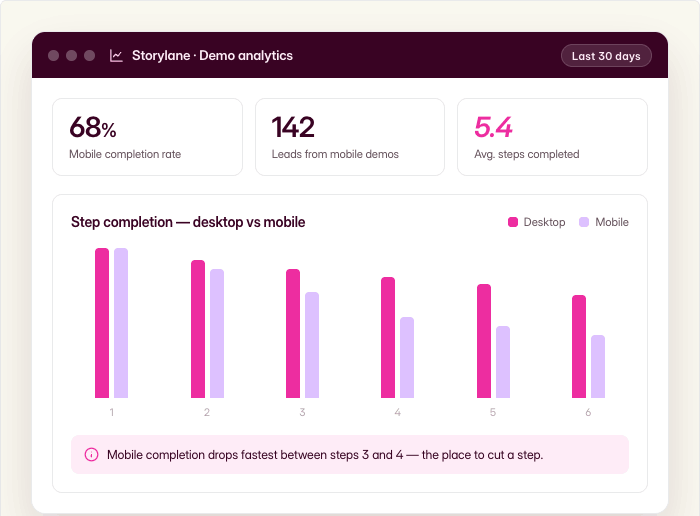
When you send an interactive demo, you get data back: who viewed it, which sections they explored, how long they spent, and whether they shared it with others. This is information that transforms your follow-up from generic to surgical.
Example: After sending a leave-behind, you see that the prospect's IT director spent six minutes on the SSO integration section and replayed the data encryption walkthrough twice. Your next email: "I noticed your team had some questions about our security architecture. Want me to set up a 20-minute deep-dive with our security engineer?"
How you can implement it:
- Review engagement data within 24 hours of sending any interactive demo
- Flag prospects who haven't viewed the demo after 48 hours and send a brief nudge
- Use view data to personalize your follow-up: reference specific sections they explored or skipped
- Share engagement signals with your AE so your next outreach is aligned
Sharpen your demo craft over time
Demo skills compound. The SEs who improve fastest treat every demo as practice, not just a sales activity.
Shadow your teammates. Sit in on demos run by other SEs on your team, especially those with different styles or selling into different segments. You'll pick up transitions, objection-handling techniques, and product angles you hadn't considered.
Record and review. Watch your own demo recordings. It's uncomfortable, and it's the fastest way to spot filler words ("um," "so basically," "as you can see"), pacing issues, and moments where you talked past the prospect's question.
Ask for feedback. After a demo, ask the prospect: "Was there anything I could have explained more clearly?" After a deal closes (win or lose), ask the AE what the buyer said about the demo in later conversations.
Practice live-presentation skills. Demo delivery is a performance skill. Practice transitions, timing, and recovery from unexpected questions. The SEs who look effortless on calls are the ones who rehearse the most.
Example: An SE noticed from watching her own recordings that she used "as you can see" 14 times in a single demo. She set a goal to replace every instance with a direct statement about what the feature does for the buyer. Within two weeks, her demos sounded sharper and prospects asked more engaged questions.
How you can implement it:
- Shadow one teammate demo per month and write down two techniques to try
- Review one of your own recordings per week and note one thing to improve
- Add "demo feedback" as a standing question in your deal retrospectives
- Set a quarterly skill goal: this quarter, work on pacing; next quarter, work on handling multi-stakeholder rooms
Tools that help sales engineers demo better
The demo tool category has grown rapidly over the past few years, with more options than ever for SEs who want to level up their workflow. Here are the categories that matter most.
Discovery and call intelligence. These tools record calls, transcribe conversations, and surface key moments. They help you prepare for demos by reviewing what the AE discussed in earlier calls and capture what the prospect said during your demo for follow-up.
Demo automation and interactive demo platforms. This is the category that directly addresses the SE pain points covered in this guide: demo automation platforms let you capture your product, build interactive walkthroughs, personalize per prospect, and share as leave-behinds. Storylane is the #1-rated platform in this category on G2, with a 4.8-star rating across 1,400+ reviews and 5,000+ B2B teams using it to build over 200,000 demos. For SEs specifically, it covers sandbox demos, Presenter Mode for live calls, choose-your-own-adventure flows, personalized deal rooms (Hubs), and step-level analytics that surface buying signals.
Want to see what a well-built interactive demo looks like? Browse interactive demo examples or learn how to create an interactive demo for your product.
AI qualification agents. A newer category: AI agents that qualify inbound website visitors in real time, asking discovery questions and routing qualified leads directly to the right SE or AE. Storylane's RepX is an example, handling inbound qualification so the SE only gets pulled in for prospects who are genuinely evaluating.
Curious about how the demo engineer role fits into all this? It's a growing specialty worth watching.
FAQ
How should a sales engineer run a product demo?
Start with discovery to understand the buyer's specific pain points and technical requirements. Set a clear advancing goal (the specific next step you want after the demo). Build a loose agenda around 3-4 key product moments that map to their pain. Lead with the outcome, show the product in action (don't just narrate features), keep it conversational, and leave time for questions. Follow up within 2 hours with an interactive leave-behind the champion can share internally.
What's the best structure for an SE demo call?
Open by restating the buyer's #1 pain point (90 seconds). Show the result or outcome first, then explain how you get there. Cover 3-4 key product workflows tailored to their use case. Pause every 3-5 minutes for questions. Reserve the last 10-15 minutes for open Q&A. Close with a clear next step tied to your advancing goal.
What makes a great software demo from a sales engineer?
Use a clean, stable demo environment (not your live production instance). Personalize the data so it looks relevant to the buyer's industry and use case. Show, don't tell: click through real workflows instead of describing them. Tailor depth to the room. Keep it a conversation. Send an interactive leave-behind afterward.
What is a sales demo in the context of presales?
A sales demo is a live or interactive product demonstration where a seller shows a prospective buyer how the product solves their specific problem. For SEs and SCs, it's the primary vehicle for technical validation: the moment where the buyer decides whether the product actually works for their use case.
What's the difference between a sales engineer, solutions consultant, and presales?
The titles describe the same function. A sales engineer, solutions consultant, and presales professional all own the technical win during the sales cycle: running product demos, managing proof-of-concept evaluations, and translating buyer pain into product fit. The differences are organizational, not functional.
How do you keep a live demo from breaking?
Present from a pre-curated environment rather than your live production instance. Options include a sandbox with locked test data, interactive demos built from captured product screens, or a combination. Audit every dependency that could fail mid-call: databases, third-party APIs, shared test accounts, deployment schedules. Always keep a backup interactive demo ready so you can switch without the prospect noticing.
How do you personalize a demo without spending hours on each one?
Build 3-5 base demo templates covering your most common buyer personas and use cases. Use dynamic tokens and search-and-replace personalization to swap in prospect-specific data (company name, industry references, relevant pain points) in minutes. Create modular sections (security, integrations, ROI) you can add to any base template. Total personalization time drops from hours to 10-15 minutes per demo.
How many demos does it usually take to close a deal?
It varies by deal complexity and sales stage. For mid-market SaaS deals, 1-2 demos (a first-touch and a deep-dive) is common. Enterprise deals with large buying committees often require 3-5 demos across different stakeholder groups. The average B2B demo-to-close rate is 25%, climbing to 30% in SaaS and 38% with interactive demos (Optifai, 939 companies, Q2 2025-Q1 2026).
The practices in this guide work whether you're an SE running 5 demos a week or 15, selling to mid-market or enterprise, using the title "sales engineer" or "solutions consultant." The fundamentals are the same: understand the buyer before you demo, structure for attention, remove environment risk, personalize at scale, and equip the champion to sell internally after you leave the call.
If you want to put these practices into action with a platform built for presales and sales engineers, Storylane gives you interactive demos, sandbox environments, personalized deal rooms, and engagement analytics, all from a single platform rated #1 on G2 with 4.8 stars across 1,400+ reviews.
Sign up and build your first demo in minutes.

.svg)